
Artificial Intelligence vs. Amplified Intelligence: What’s the Real Difference?

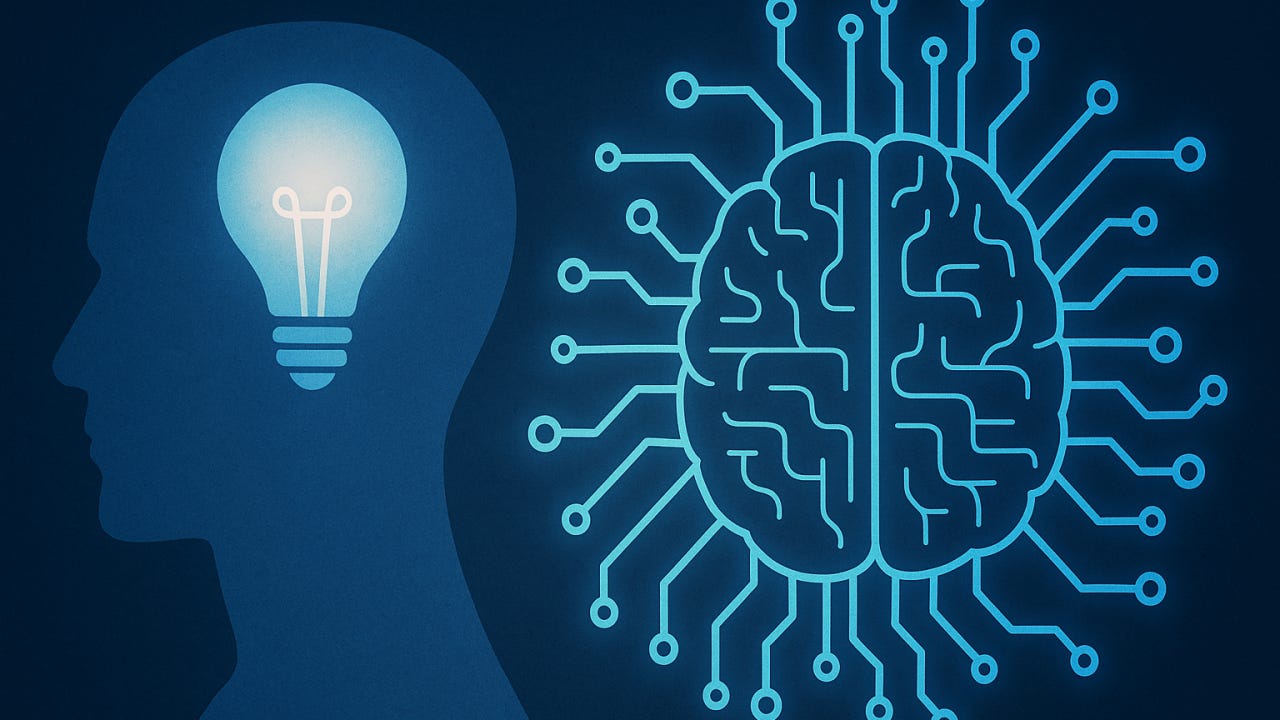
Whenever Artificial Intelligence (AI) comes up in conversation, reactions tend to fall between two extremes: fascination with its power, or fear of being replaced by it.
But is that really the right way to look at the future?
Maybe it’s not just about what the machine can do alone, but what we can do together with it.
That’s where the distinction between Artificial Intelligence (AI) and Amplified Intelligence (IAmp) begins.
The Artificial Intelligence Paradigm
AI, as it was originally conceived, is essentially autonomous.
It processes data, recognizes patterns, executes tasks — and is often portrayed as a “copy of the human,” capable of competing with us in our own domains.
This narrative fuels the imagination: the machine versus us. It can be useful, but it also creates anxiety, because it challenges our sense of relevance.
The Shift to Amplified Intelligence
Amplified Intelligence doesn’t view technology as a replacement — but as a cognitive partner.
Humans bring context, intuition, creativity, and purpose.
AI brings speed, organization, scale, and analytical precision.
Together, they create something new: a hybrid intelligence that didn’t exist before.
It’s not a simple sum. It’s an interweaving.
IAmp happens when human reasoning and machine processing meet to generate results that neither could achieve on their own.
The Dance Metaphor
Imagine a couple dancing.
If both insist on leading, the movement turns into a struggle. But if they understand their roles and find the rhythm, something greater emerges: fluidity, improvisation, co-creation.
Artificial Intelligence alone is like dancing in the void.
Amplified Intelligence is learning to dance together: a dialogue of steps, mistakes, adjustments, and discoveries.
This metaphor reveals that the real value doesn’t lie in “who leads better,” but in learning to create harmony through improvisation.
From Replacement to Amplification
The biggest mistake is reducing AI to a binary question: it either replaces us, or it doesn’t.
That view is short-sighted and ignores the cognitive dimension of the process.
With IAmp, the question changes:
It’s not “Will the machine think for us?”
It’s “How do we train our minds to think together with it?”
That’s the turning point — from competition to cooperation, from threat to leverage.
What’s at Stake
If we keep viewing AI only as a replacement, we’ll miss the opportunity to expand human potential.
But if we understand the logic of Amplified Intelligence, we can transform these tools into active extensions of our thinking — enhancing our creativity, decision-making, and capacity to learn.
In the end, it’s not about machines versus humans, but about humans who know — or don’t know — how to dance with machines.
A Question to Reflect On
If you could choose one area of your life or work to experiment with Amplified Intelligence, which one would it be?